ABOUT LANZAROTE :
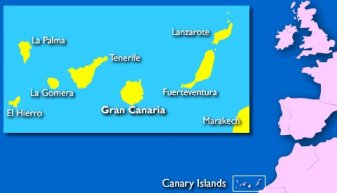 Lanzarote
is the most easterly of the seven inhabited islands in the Atlantic Ocean that
form the Canary Islands. The island is 37 miles (60km) long and 12 miles (20km)
wide. Lanzarote enjoys a mild dry climate and whilst it is situated just 68 miles off the
west coast of Africa it is no desert island. Average daytime temperatures range from 21°C
in January to 29°C in August and annual rainfall is just 140mm (5.5 inches) - this
makes Lanzarote the perfect year-round destination.
Lanzarote
is the most easterly of the seven inhabited islands in the Atlantic Ocean that
form the Canary Islands. The island is 37 miles (60km) long and 12 miles (20km)
wide. Lanzarote enjoys a mild dry climate and whilst it is situated just 68 miles off the
west coast of Africa it is no desert island. Average daytime temperatures range from 21°C
in January to 29°C in August and annual rainfall is just 140mm (5.5 inches) - this
makes Lanzarote the perfect year-round destination.
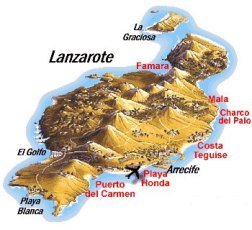 As with the other Canary Islands, Lanzarote is volcanic in origin
- the unusual landscape is largely a result of the last eruptions occurring in the 19th century. The dramatic landscape
is often described as lunar, so much so that parts of 'Planet of the Apes' were
shot here.
As with the other Canary Islands, Lanzarote is volcanic in origin
- the unusual landscape is largely a result of the last eruptions occurring in the 19th century. The dramatic landscape
is often described as lunar, so much so that parts of 'Planet of the Apes' were
shot here.
Most buildings on the island, even modern
ones, are white painted and low-rise, an architecture largely dictated by César
Manrique when he was given the task of shaping Lanzarote as a tourist
island in the 1960s and 1970s. It is impossible to imagine Lanzarote as it
stands today without César
Manrique. He was a painter, sculptor, architect and ecologist. Manrique felt
that he had to transform the island before the increasing amounts of tourists
overwhelmed and disfigured it irreversibly. With his great intuition combined
with his incredible artistic ability he identified various areas in Lanzarote
and improved their intrinsic beauty. He died at the age of 73 in a tragic car
accident in 1992, however his legacy lives on thanks to his ingenious work and
the César
Manrique Foundation, a museum situated at the unique house that the artist
designed and occupied.
PLACES TO VISIT WHILST IN LANZAROTE :
Timanfaya National Park:
 This area of over 50
km² consists of over 100
This area of over 50
km² consists of over 100
 volcanoes
that erupted between 1730 and 1736 devastating this part of the island,
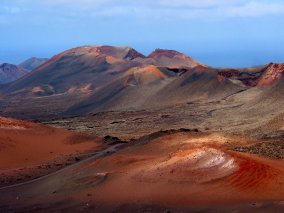
including several villages. The area is known as 'The Montañas del Fuego' (Fire
Mountains) and it appears much the same as it did in 1824 after the last
eruptions as the low rainfall on the island has not caused erosion.
volcanoes
that erupted between 1730 and 1736 devastating this part of the island,
including several villages. The area is known as 'The Montañas del Fuego' (Fire
Mountains) and it appears much the same as it did in 1824 after the last
eruptions as the low rainfall on the island has not caused erosion.
There is an admission
fee to the park which includes a guided coach tour around the volcanoes. The
temperature a few metres below the surface reaches between 400°C and 600°C and
to demonstrate this, guides throw dry bush into a hole in the ground which
catches fire immediately
 and
water is poured into a bore hole which erupts seconds later as steam.
and
water is poured into a bore hole which erupts seconds later as steam.
There is also the 'El
Diablo' restaurant serving traditional Canarian food that you can watch being
cooked from the heat of the volcano. You can also take a Camel ride from here
across the volcanic terrain.
Opening Hours: 10:00 - 18:00 Everyday
The César
Manrique Foundation:
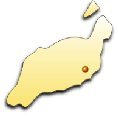 This is
situated in the house at Taro de Tahiche that César occupied. It was built in
1968 in the lava flow
This is
situated in the house at Taro de Tahiche that César occupied. It was built in
1968 in the lava flow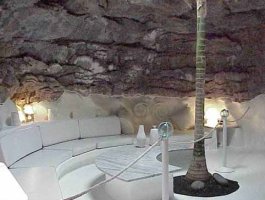 from volcanic activity during 1730 - 1736. The underground living area is built
into five volcanic bubbles in the lava flow and has a real 'James Bond' feel to
it, whilst the upper area and the outside are inspired by traditional Lanzarote
Architecture.
from volcanic activity during 1730 - 1736. The underground living area is built
into five volcanic bubbles in the lava flow and has a real 'James Bond' feel to
it, whilst the upper area and the outside are inspired by traditional Lanzarote
Architecture.
The upper areas are now
a museum that's houses César's contemporary art collection. There is a small
sample of contemporary art from the Canary Islands and includes three halls
dedicated to Manrique.
Opening Hours:
10:00 - 18:00 Monday - Saturday
Facilities: Bar and
Cafeteria
Jameos
del Agua:
 Lanzarote
is home to one of the most interesting series of connecting caves and grottoes
in the world, the
Lanzarote
is home to one of the most interesting series of connecting caves and grottoes
in the world, the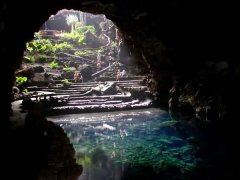 result of the eruption of Monte de la Corona around 3,000 years ago. "Jameos"
means bubbles of lava. A jameo is formed when a tunnel ceiling collapses, most
often occurring when its width exceeds twenty meters, or when gases accumulate
and explode. The caves were formed when a stream of molten lava met the nearby
waters of the Atlantic. César
Manrique has created a natural tourist attraction around these natural caves.
result of the eruption of Monte de la Corona around 3,000 years ago. "Jameos"
means bubbles of lava. A jameo is formed when a tunnel ceiling collapses, most
often occurring when its width exceeds twenty meters, or when gases accumulate
and explode. The caves were formed when a stream of molten lava met the nearby
waters of the Atlantic. César
Manrique has created a natural tourist attraction around these natural caves.
Within one of the caves is an underground salt
water lagoon with crystal clear water and a lake bed covered with albino crabs
that are unique in the sea world at this depth. A final cave contains an
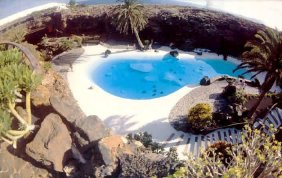 astonishing
underground concert hall, seating 600 spectators with its own natural acoustics.
There is also an outdoor pool area with lush sub-tropical vegetation and a
museum on the upper floor contai
astonishing
underground concert hall, seating 600 spectators with its own natural acoustics.
There is also an outdoor pool area with lush sub-tropical vegetation and a
museum on the upper floor contai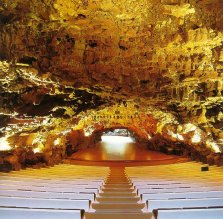 ning
history of volcanic activity in Lanzarote. A camera is a must here to take the
obligatory photo in the infinity mirrors.
ning
history of volcanic activity in Lanzarote. A camera is a must here to take the
obligatory photo in the infinity mirrors.
Opening Hours: Daily
9:30 - 19:00
Facilities: Bar and Restaurant
El Golfo and Los Hervideros:
 El
Golfo is a semi-circular volcanic crater that has been eroded by the sea. It is
separated from the sea and
El
Golfo is a semi-circular volcanic crater that has been eroded by the sea. It is
separated from the sea and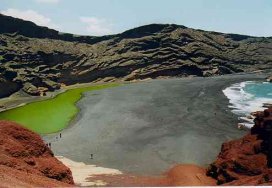 filled by sea water that has filtered through the black sand. The algae living
in the water have created a green lagoon which makes for a quite spectacular
sight as it contrasts with the black sand beach and the weird looking rock
formations surrounding it.
filled by sea water that has filtered through the black sand. The algae living
in the water have created a green lagoon which makes for a quite spectacular
sight as it contrasts with the black sand beach and the weird looking rock
formations surrounding it.
The village of El Golfo has a real 'end of the
road' feel to it and it is full of restaurants serving fresh fish dishes. It is
worth staying for a meal at one of the seafront restaurants watching the coast
line face the full force of the
Atlantic Ocean.
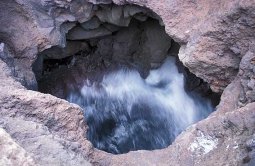 Los
Hervideros, just south of El Golfo, is a series of caves and blow holes that
have been eroded into a former lava flow.
The name means the 'boiling pots' - and
you can understand how the area got that name when you see the sea pounding in
at high tide - especially when there is a strong following wind. It is quite
something to see the huge waves drive into the narrowing space between the
cliffs and then explode into the numerous crevices and lava bubbles, from which
they are repelled with great force. It is possible to walk around the cliffs
here and watch the breakers from one of the natural 'balconies'.
Los
Hervideros, just south of El Golfo, is a series of caves and blow holes that
have been eroded into a former lava flow.
The name means the 'boiling pots' - and
you can understand how the area got that name when you see the sea pounding in
at high tide - especially when there is a strong following wind. It is quite
something to see the huge waves drive into the narrowing space between the
cliffs and then explode into the numerous crevices and lava bubbles, from which
they are repelled with great force. It is possible to walk around the cliffs
here and watch the breakers from one of the natural 'balconies'.
Puerto Calero:
 Puerto
Calero is one of Europe's most beautiful marinas and even if you are not of the
boating fraternity
Puerto
Calero is one of Europe's most beautiful marinas and even if you are not of the
boating fraternity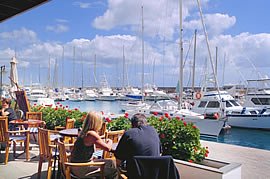 you can enjoy a leisurely stroll around the marina watching the shoals of fish
in the water, browsing the shops and finally dining in one of numerous
restaurants offering a wide range of international and local cuisine whilst
watching luxury motor cruisers and fabulous sailing boats make their way across
the harbour. You can take a trip on a real yellow submarine to see the
underwater world, take a cruise to go deep sea fishing, or cruise to the golden
beaches of Papagayo on a catamaran.
you can enjoy a leisurely stroll around the marina watching the shoals of fish
in the water, browsing the shops and finally dining in one of numerous
restaurants offering a wide range of international and local cuisine whilst
watching luxury motor cruisers and fabulous sailing boats make their way across
the harbour. You can take a trip on a real yellow submarine to see the
underwater world, take a cruise to go deep sea fishing, or cruise to the golden
beaches of Papagayo on a catamaran.
Teguise Market:
 Teguise
is the old capital of Lanzarote and one of its most popular events is the
massive open air Sunday
Teguise
is the old capital of Lanzarote and one of its most popular events is the
massive open air Sunday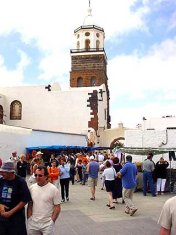 Market, an ideal spot to hunt down souvenirs and gifts at a bargain price.
Thousands of people go to Teguise in the few hours that the market is open, the
market traders are from the mainland and also from Morocco and Senegal. There
are also many musicians and singers in native costume.
Market, an ideal spot to hunt down souvenirs and gifts at a bargain price.
Thousands of people go to Teguise in the few hours that the market is open, the
market traders are from the mainland and also from Morocco and Senegal. There
are also many musicians and singers in native costume.
The village itself has a wealth of interesting
shops selling local arts, local produce and antique furnishings imported from
the orient. There are also plenty of places to stop and have a meal or just
relax with a drink.
Opening Hours: Sunday 10:00 - 14:00